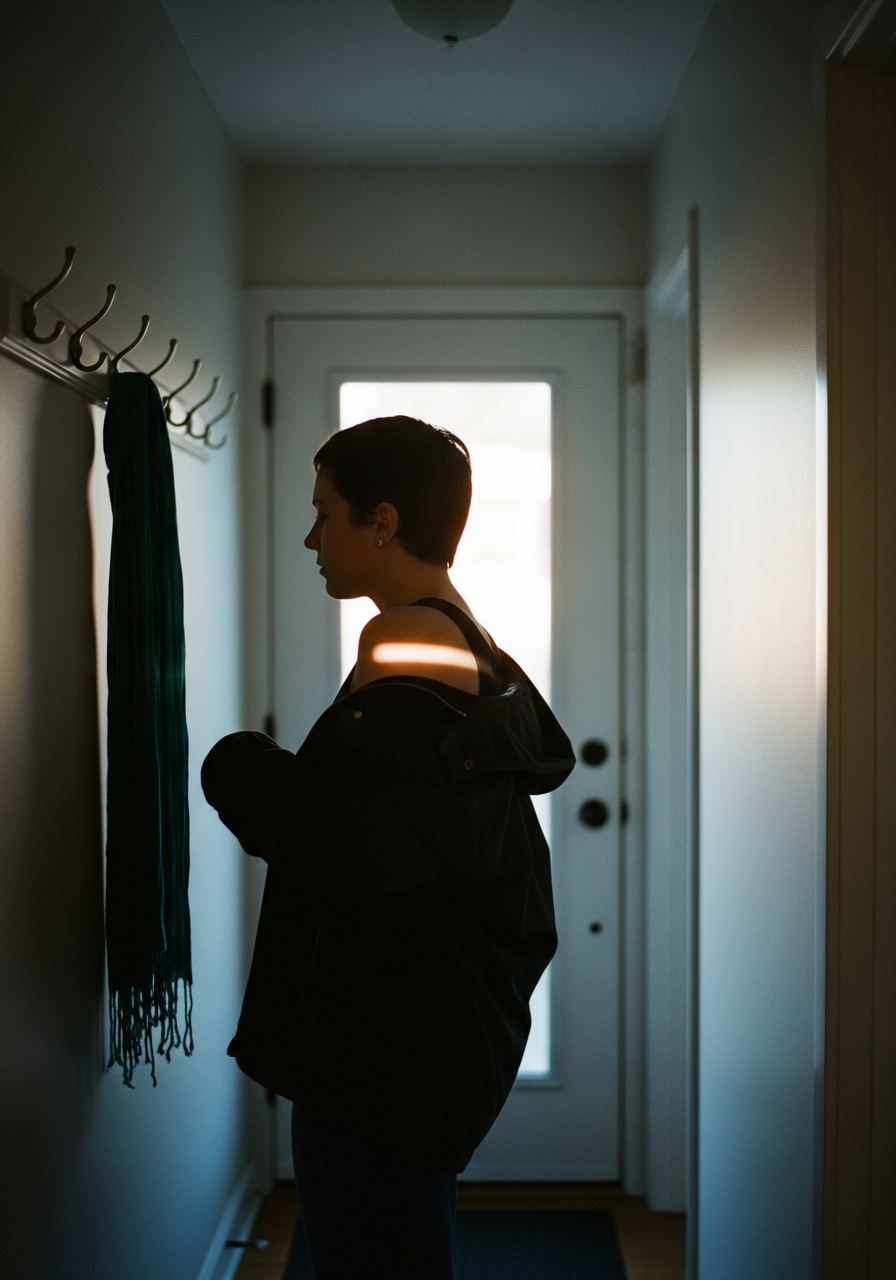
The visit ends. The door closes, or the gate calls your flight, and within a day you’re texting someone who, twenty-four hours ago, was lying next to you — and it feels weirdly formal.
That’s the part nobody warns you about. Not the goodbye. The re-entry.
You spent a week being a real couple, sharing a bed and a bathroom and a hundred unspoken things, and now you’re back to a screen and a time difference and a strange politeness that wasn’t there before. You feel like strangers for a bit. And learning how to reconnect with your partner after time apart starts with admitting that gap exists instead of frantically papering over it.
Why You Feel Like Strangers After Being So Close
Here’s what actually happened: for a few days, you both dropped the version of the relationship you maintain over distance and lived inside the real one. Then it ended, and you had to switch back.
That switch costs something. In person, intimacy is cheap — it’s in the room, in the shared meals, the touch, the way you read each other’s mood without a word. Over distance, you have to manufacture all of that deliberately, and your nervous system doesn’t enjoy the downgrade.
So it protects you. It pulls back. The sudden coolness you feel isn’t a sign the relationship is failing — it’s your own system bracing against the loss of something it just got used to having. Both of you do it. Both of you read the other person’s bracing as distance, and then you brace harder in response.
That’s the loop. Two people who missed each other desperately, now performing politeness at each other across a screen, each privately wondering if something changed.
Nothing changed. You’re just both in re-entry, and neither of you is saying it out loud.
The Mistake Almost Everyone Makes
The instinct is to pretend the gap isn’t there. To jump straight back into “us” — same banter, same warmth, same volume — as if no transition is happening.
It doesn’t work, because you’re forcing a connection that hasn’t reformed yet. You send the heart emoji and it feels hollow. You try to be playful and it lands flat. Then you panic a little, because the flatness seems to confirm your worst fear: that the closeness you had during the visit wasn’t real, or that it doesn’t survive the distance.
The other mistake is the opposite — going quiet. Telling yourself you’re “giving each other space” when you’re actually just both hiding from the awkwardness. A day of that becomes three, and now the silence itself is the problem, and you’ve built a small wall out of nothing but mutual avoidance.
Neither pretending nor hiding closes the gap. The only thing that closes it is naming it.
Name the Re-Entry Out Loud
The single most useful thing you can do is say the quiet part: “I always feel a bit weird and far away for a few days after you leave. It’s not you. I think I just miss having you here.”
That one sentence does more than a week of forced cheerfulness. It tells your partner the coolness they’re sensing is real and explainable and not about them. It gives them permission to admit they feel it too — which they almost certainly do, and which they’ve probably been too scared to say.
Re-entry is so much easier when both of you know you’re in it. The awkwardness stops being a verdict on the relationship and becomes a phase you’re moving through together. You can even name it as a shared thing: “the weird couple of days.” Once it has a name, it loses most of its power.
This is the same dynamic that runs underneath most communication breakdowns between partners — the problem usually isn’t the thing you’re feeling, it’s that you’re feeling it silently and assuming the worst about what the silence means.
Rebuild Closeness on Purpose, Not by Accident
Once you’ve named the gap, you have to actually close it — and after time apart, closeness doesn’t reassemble on its own. You have to feed it specific raw material.
Trade one real thing each, not just logistics. The fastest way back into the surface trap is letting the first calls become status updates — work, sleep, what you ate. Instead, each of you says one true thing about how you’re actually doing since the visit ended. Not “I’m fine, you?” The real version.
Reference the visit instead of avoiding it. There’s a temptation to not talk about the time together because it makes the absence sharper. Do the opposite. “I keep thinking about that thing you said on the second night.” Pulling the good moments forward keeps the connection warm instead of letting it freeze over.
Do something that requires reacting to each other, not just watching in parallel. The goal isn’t to fill time — it’s to generate the kind of back-and-forth that rebuilds the feeling of being a unit. This is exactly why some forms of distance intimacy work and others leave you colder: presence is built from reaching toward each other, not from logging hours on a call.
Give it a few days without panicking. Re-entry has a half-life. If you name it and stay in contact and resist the urge to read meaning into every flat exchange, the strangeness burns off on its own. Usually faster than you expect. The couples who survive distance long-term aren’t the ones who never feel the gap — they’re the ones who stopped treating the gap as an emergency.
If naming it out loud feels like too much while you’re still raw, it sometimes helps to first get clear on what you’re actually feeling — sorting the missing-them from the resentment from the plain exhaustion. A private space to gather your own thoughts before you reconnect can make the difference between sending the honest message and sending the defensive one.
None of this is about engineering the perfect post-visit conversation. It’s about refusing to let a normal, temporary distance harden into a real one — which is the whole game in a relationship measured in the long stretches between being together.
The strangers feeling is normal. Send this to your partner before the next goodbye — so you both know what the weird couple of days actually is.